DEFINITIONS OF OXIDATION AND REDUCTION (REDOX)
This page looks at the various definitions of oxidation and reduction (redox) in terms of the transfer of oxygen, hydrogen and electrons. It also explains the terms oxidising agent and reducing agent.
Oxidation and reduction in terms of oxygen transferDefinitions
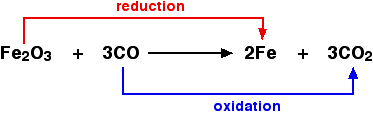 Oxidising and reducing agents An oxidising agent is substance which oxidises something else. In the above example, the iron(III) oxide is the oxidising agent. A reducing agent reduces something else. In the equation, the carbon monoxide is the reducing agent.
Definitions
For example, ethanol can be oxidised to ethanal: 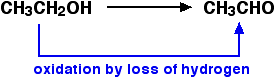 | |
Note: The equation for this is rather complicated for this introductory page. If you are interested, you will find a similar example (ethanol to ethanoic acid) on the page dealing with writing equations for redox reactions. | |
Ethanal can also be reduced back to ethanol again by adding hydrogen to it. A possible reducing agent is sodium tetrahydridoborate, NaBH4. Again the equation is too complicated to be worth bothering about at this point.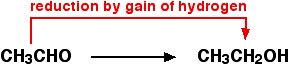
Definitions
 The equation shows a simple redox reaction which can obviously be described in terms of oxygen transfer.   Copper(II) oxide and magnesium oxide are both ionic. The metals obviously aren't. If you rewrite this as an ionic equation, it turns out that the oxide ions are spectator ions and you are left with: 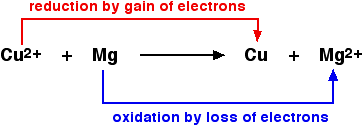 If you look at the equation above, the magnesium is reducing the copper(II) ions by giving them electrons to neutralise the charge. Magnesium is a reducing agent. Looking at it the other way round, the copper(II) ions are removing electrons from the magnesium to create the magnesium ions. The copper(II) ions are acting as an oxidising agent. Warning! This is potentially very confusing if you try to learn both what oxidation and reduction mean in terms of electron transfer, and also learn definitions of oxidising and reducing agents in the same terms. Personally, I would recommend that you work it out if you need it. The argument (going on inside your head) would go like this if you wanted to know, for example, what an oxidising agent did in terms of electrons:
| |
Sunday, August 26, 2018
OXIDASITION AND REDUCTION REACTION

Tuesday, August 21, 2018
PRAY FOR KERALA

THE TIMES OF INDIA | AUG 21, 2018 , 12:53:34 IST
Kerala floods live updates: Over 10 lakh in relief camps; Centre declares disaster 'calamity of severe nature'
Live Updates
FILTER UPDATES
No one will be allowed to distribute food or any other items directly to the relief camps. Everyone should donate the relief materials to the district administration or the people who are heading the camps

Commercial flight operations from the naval airport at Kochi commenced on Monday with the first Air India flight from Bengaluru arriving in the morning. Small aircrafts are being operated from the naval airport as the Kochi International Airport has shut operations till August 26 following flooding of the runways
Wednesday, August 15, 2018

Wednesday, August 8, 2018
CHEMISTERY------- COVALENT BOND
Covalent Bond Definition
A covalent bond is a chemical link between two atoms or ions where the electron pairs are shared between them. A covalent bond may also be termed a molecular bond. Covalent bonds form between two nonmetal atoms with identical or relatively close electronegativity values. This type of bond may also be found in other chemical species, such as radicals and macromolecules. The term "covalent bond" first came into use in 1939, although Irving Langmuir introduced the term "covalence" in 1919 to describe the number of electron pairs shared by neighboring atoms.
The electron pairs that participate in a covalent bond are called bonding pairs or shared pairs. Typically, sharing bonding pairs allows each atom to achieve a stable outer electron shell, similar to that seen in noble gas atoms.
Polar and Nonpolar Covalent Bonds
Two important types of covalent bonds are nonpolar or pure covalent bonds and polar covalent bonds. Nonpolar bonds occur when atoms equally share electron pairs. Since only identical atoms (same electronegativity as each other) truly engage in equal sharing, the definition is expanded to include covalent bonding between any atoms with an electronegativity difference less than 0.4. Examples of molecules with nonpolar bonds are H2, N2, and CH4.
As the electronegativity difference increases, the electron pair in a bond is more closely associated with one nucleus than the other. If the electronegativity difference is between 0.4 and 1.7, the bond is polar. If the electronegativity difference is greater than 1.7, the bond is ionic.
Covalent Bond Examples
There is a covalent bond between the oxygen and each hydrogen in a water molecule(H2O). Each of the covalent bonds contains two electrons - one from a hydrogen atom and one from the oxygen atom. Both atoms share the electrons.
A hydrogen molecule, H2, consists of two hydrogen atoms joined by a covalent bond. Each hydrogen atom needs two electrons to achieve a stable outer electron shell. The pair of electrons is attracted to the positive charge of both atomic nuclei, holding the molecule together.
Phosphorus can form either PCl3 or PCl5. In both cases, the phosphorus and chlorine atoms are connected by covalent bonds. PCl3 assumes the expected noble gas structure, where the atoms achieve complete outer electron shells. Yet PCl5 is also stable, so it's important to remember covalent bonds don't always abide by the octet rule.
Kourtney Kardashian
Kourtney Kardashian and Younes Bendjima have called it quits, a source confirms to PEOPLE, adding that “it didn’t end well.”
The news comes as photos of Bendjima getting cozy with another woman in Mexico on Monday surfaced on TMZ. On his Instagram story, Bendjima denied the situation was romantic, writing: “They really want me to be the bad guy. F— your Hollywood bulls—, can’t have fun with your friends no more.”
The couple was going strong as recently as last month, when they took a romantic European vacation joined in part by the three children she shares with ex Scott Disick: Mason, 8, Reign, 3, and Penelope, 5.
But tensions had been lingering over Kardashian’s social media activity. During the three-week trip, she posted multiple photos on Instagram showing off her toned physique in bathing suits, including two photos of her eating bread in a bikini while lounging on a yacht.
In a since-deleted comment on a photo of Kardashian, 39, wearing a thong bikini, Bendjima, 25, shaded the post, writing: “That’s what you need to show to get likes?”
A source later told PEOPLE Bendjima was never a fan of his girlfriend’s revealing shots.
“He never liked that she posted sexy pictures of herself on social media,” said the source. “He doesn’t want his girlfriend to do that. He gets that it’s her job, but wants her to post more covered-up pictures. He has always had a problem with this. This is the stuff they argue about and what made them split in the past.”
Tuesday, August 7, 2018
Karunanidhi's death
Chennai: Dravida Munnetra Kazhagam (DMK) chief M Karunanidhi passed away on Tuesday at the age of 94 after a prolonged illness. Kalaignar, as he was fondly called, breathed his last at 6:10 pm. The Kauvery Hospital had earlier in the evening said that the DMK chief's health condition had become "extremely critical and unstable". Karunanidhi was admitted to the Kauvery Hospital on July 28 following a drop in his blood pressure.
Hundreds of supporters were outside the Kauvery Hospital as the news of the DMK patriarch's death was announced in the evening. Al turned emotional with most of them started to cry. Earlier, the state DGP had ordered tightening of security across Tamil Nadu to maintain law and order situation.
Monday, August 6, 2018
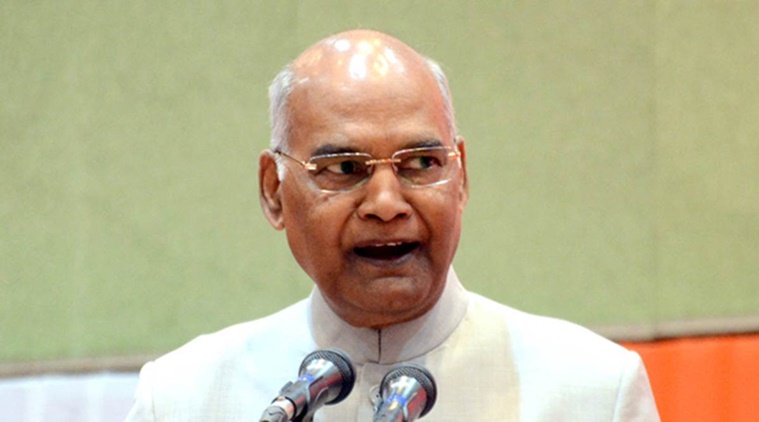
Kerala temple priest arrested for threatening bomb attack at President Kovind function venue
X
At around 1 am last night, the man, who was in an inebriated state, called up the police control room in Kerala and threatened to plant a bomb at the college where the president would inaugurate the centenary celebrations Tuesday, they added.
Thrissur District Police chief Yatish Chandra said the accused, Jayaraman, was picked up after his mobile phone was tracked down. During interrogation, he admitted to having made the call in an inebriated state. He is a priest at the Chirakal Bhagavathy temple here. A case was registered against him for criminal intimidation, the police said.
The president, who was on a three-day visit to Kerala, arrived in the state capital yesterday. Kovind would be inaugurating a function at the Assembly complex in Thiruvananthapuram to mark the conclusion of the diamond jubilee celebrations of the Kerala Legislative Assembly today. Tomorrow, the president would also have breakfast with the chief justice and judges of the Kerala High Court at Kochi. He would offer prayers at the famed Guruvayur Sri Krishna temple before returning to Delhi on August 8
National Sisters Day 2018 – August 5
Maybe you have an older sister that you look to for guidance. Maybe you have a younger sister who is looking to you for inspiration. Whatever the circumstance, nothing can quite compare to the bond that sisters have. So on the first Sunday in August, let’s celebrate National Sisters Day — a day to recognize the sisters who make such a difference in our lives.
WHEN IS NATIONAL SISTERS DAY 2018?
National Sisters Day is celebrated on the first Sunday of August. In 2018 that means it falls on August 5.
NATIONAL SISTERS DAY ACTIVITIES
1. Reach out
If you can't spend time with your sister in person, taking the time to call or send a card is the best gift you can give her.
If you can't spend time with your sister in person, taking the time to call or send a card is the best gift you can give her.
2. Be a good listener
That means through good times and bad. Empathy and attention can go a long way.
That means through good times and bad. Empathy and attention can go a long way.
3. Go on an adventure
Try something new together. What better way to bond with your sister than to push some boundaries.
Try something new together. What better way to bond with your sister than to push some boundaries.
WHY WE LOVE NATIONAL SISTERS DAY
A. It's a time to fix any misunderstandings
Arguments happen. So take this day to reconnect if necessary. Because it's going to feel great when you can "hug it out" again.
Arguments happen. So take this day to reconnect if necessary. Because it's going to feel great when you can "hug it out" again.
B. No sister? No problem
While it may seem like National Sisters Day is only for people who have biological sisters, your best friend can be just as close. Treat her like a sister!
While it may seem like National Sisters Day is only for people who have biological sisters, your best friend can be just as close. Treat her like a sister!
C. Cherish the memories
Life is busy, but use National Sisters Day as the opportunity to go through your old photos (and videos) and remember the good times. Then, make plans to go somewhere fun and do it all again.
Life is busy, but use National Sisters Day as the opportunity to go through your old photos (and videos) and remember the good times. Then, make plans to go somewhere fun and do it all again.
Subscribe to:
Posts (Atom)